Gracklepy: Running Grackle in Python
Grackle comes with a Python interface, called Gracklepy, which provides access to all of Grackle’s functionality.
If you are new user, we strongly recommend that you use a pre-built version of Gracklepy.
Note
Gracklepy was formerly known as Pygrackle. If you previously installed Pygrackle, you should make sure that you uninstall it before upgrading
Pre-built installation (recommended)
The easiest way to get Gracklepy is install a pre-built Gracklepy wheel from PyPI. This can be accomplished by invoking
pip install gracklepy
This command will install the Gracklepy package. Prebuilt copies of all dependencies, including the core Grackle library, are bundled with the installation (the package will use these versions of the dependencies instead of any copies you have installed on your machine).
Be aware that the vast majority of Grackle calculation requires Grackle’s data files. At this time you must download manually download these files (gh-pr#235 is a pending pull request that seeks to streamline this for the future).
You can download the datafiles from here.
Important
DO NOT try linking arbitrary external C/C++ programs against the prebuilt copy of the core Grackle library that is bundled with Gracklepy. This is something that we explicitly do not support (it is not a portable solution!)
Installation from Source Code
To install Gracklepy from its source code, you’ll need to make sure that HDF5 and a fortran compiler are installed (for building the Grackle library itself).
Gracklepy’s runtime-dependencies are:
The above dependencies are automatically installed with pip (alternatively you can follow instructions for installing yt).
If you want to run the gracklepy test-suite, you’ll need the packaging and py.test packages. If pip is up to date (25.1 or newer), you can simply invoke pip install --group dev from the root of the repository.
Currently, the only way to get Gracklepy is to build it from source.
There are 3 ways to build Gracklepy:
As a standalone, self-contained module. The build command creates a fresh build of the Grackle library and packages it with the Gracklepy module. (If you are going to build Gracklepy from source, this is the recommended way to do it)
As a module that links to an external copy of Grackle that was compiled with the Classic build system. (This is consistent with the legacy approach for building Gracklepy).
As a module that links to an external copy of Grackle that was created with the CMake build system.
Currently, Gracklepy should only be used with Grackle builds where OpenMP is disabled.
Warning
We strongly encourage you to use the first approach so that your Gracklepy installation is independent of other Grackle installations on your machine.
The latter 2 approaches are primarily intended for testing-purposes. If you use the latter 2 approaches, it’s your responsibility to ensure that you delete the old version of Gracklepy and reinstall it whenever the external Grackle library is updated. If you forget, Gracklepy may still work, but it’s more likely to produce a segmentation fault or (even worse!) silently give incorrect results.
1. Build Gracklepy as a standalone module (recommended)
To install Gracklepy, you just need to invoke the following from the root directory.
~/grackle $ pip install -v .
Under this approach, gracklepy’s python build backend, scikit-build-core, automatically builds the core Grackle library (in a CMake build), packages the resulting library as part of the gracklepy package, and cleans up from the build. If a new enough version of CMake cannot be found, the above command will automatically download CMake (it will only be accessible during the build).
While the above command should “just work,” you have a few options for customizing the build:
In most cases, you probably want to use the standard environment variables directly understood by CMake:[1]
you can specifiy your choice of C and Fortran compilers that are used for this by manipulating the
CCandFCenvironment variables.if you must pass extra compiler flags to all invocations of the C or Fortran compiler (this shouldn’t really be necessary), you can use the
CFLAGSorFFLAGSenvironment variable.to provide a hint about the location of the hdf5 library you can use
HDF5_ROOTorHDF5_DIR(these behave similarly to the CMake variables of the same name).
Alternatively, you can specify the values of CMake variables.
Recall that when you are directly using the CMake build system to build a project, you configure build-properties by defining CMake variables. As we explain elsewhere, this is commonly accomplished by listing arguments of the form
-D<variable>=<value>when we call CMake on the command line.Things are a little different in the context of building gracklepy, since we aren’t invoking CMake, directly. Instead we need to instruct the scikit-build-core python build-backend to forward arguments onto CMake.
There are effectively 2 ways of doing this: (i) specify this information as extra command line arguments when invoking
pip installOR (ii) we can specify it through an environment variable understood by scikit-build-core
For the sake of concreteness, let’s imagine that you want to assign the CMake variables
CMAKE_C_COMPILERandHDF5_ROOTvalues ofgcc-14and/path/to/hdf5. The following code-snippets illustrate how to do this:If using a version of pip from before 23.1, you need to replace
-Cwith--config-settings=in the following snippet.~/grackle $ pip install -v . -Ccmake.args=-DCMAKE_C_COMPILER=gcc-14;-DHDF5_ROOT=/path/to/hdf5You can use the use the
SKBUILD_CMAKE_ARGSenv variable, where each argument is separated by semicolons, orCMAKE_ARGS, where each argument is separated by a space.~/grackle $ export SKBUILD_CMAKE_ARGS="-DCMAKE_C_COMPILER=gcc-14;-DHDF5_ROOT=/path/to/hdf5" ~/grackle $ pip install -v .
~/grackle $ export CMAKE_ARGS="-DCMAKE_C_COMPILER=gcc-14 -DHDF5_ROOT=/path/to/hdf5"
~/grackle $ pip install -v .
Tip
If you are looking to modify a standard CMake option, you should generally check scikit-build-core’s documentation; there are some special cases.
Consider the CMAKE_BUILD_TYPE variable, which controls optimiziation flags and the presence of debugger symbols.
Rather than directly modifying this variable, you should modify scikit-build-core’s cmake.build-type variable.
If you wanted to set it to Debug, you might do one of the following options:
If using a version of pip from before 23.1, you need to replace -C with --config-settings= in the following snippet.
~/grackle $ pip install -v . -Ccmake.build-type="Debug"
You can would store "Debug" within the SKBUILD_CMAKE_BUILD_TYPE env variable
If you encounter any compilation problems, you can also link Gracklepy against a version of the Grackle library that you already built.
(In the event that you are writing an external python package that depends on directly linking to the underlying Grackle library, be aware that the underlying organization of files in the resulting package may change. We have no plans to support this scenario.)
2. Link to external Grackle library (built with Classic build system)
Prerequisite: This scenario assumes that you have already built Grackle with the Class build system.
To build Gracklepy, we use the GRACKLEPY_LEGACY_LINK environment variable to indicate that we want to that external build.
Specifically, that variable must be configured as GRACKLEPY_LEGACY_LINK=classic.
~/grackle $ GRACKLEPY_LEGACY_LINK=classic pip install .
Note
We explicitly try to maintain the legacy behavior of the older setuptools-based python build-system. This means that we use the copy of the Grackle shared library from the build directory during linking (i.e. Gracklepy will happily build even if Grackle isn’t fully installed).
We then ASSUME that a copy of the Grackle shared library will be in a location known to the system, when you try to run Gracklepy.
This could be a standard system location for libraries (on some systems you may need to invoke ldconfig after installation).
This could also be a location specified by the relevant variable; LD_LIBRARY_PATH if you’re on Linux (or most unix-like systems) or DYLD_LIBRARY_PATH (if you’re on macOS)
3. Link to external Grackle library (built with the CMake build system)
Prerequisite: This scenario assumes that you have already built (and possibly installed) Grackle with the CMake build system.
Specifically, that cmake build must have compiled Grackle as a shared library (the primary way to ensure this happens is by passing the -DBUILD_SHARED_LIBS=ON flag when using cmake to configure the build).
To build Gracklepy in this way, you must initialize either the Grackle_DIR environment variable or the Grackle_ROOT environment variable with the relevant path for your prebuilt Grackle library.
This path can either point to cmake build directory (where Grackle is built) OR an installation directory.
We illustrates how to install Gracklepy under this approach down below.
For the sake of example, we assume that we previously used cmake to build (and compile) Grackle as a shared library in a build directory called ~/grackle/build.
The default command to build Gracklepy against a CMake-built is shown below. By default, this approach assumes that the Grackle shared library will never move. This means that issues will occur if you delete or move the Grackle library. (This is a necessary assumption in order to support build directories).
~/grackle $ Grackle_DIR=${PWD}/build pip install .
It’s also possible to achieve linking behavior more similar to the case where we build Gracklepy against an external Grackle library that was built with the classic build system (this is consistent with the behavior implemented by Gracklepy’s former setuptools build system).
Under this scenario, no relationship is assumed between the path to the Grackle shared library that is used while building Gracklepy and the path that is used while running Gracklepy.
Instead, we assume that the Grackle shared library will be at an arbitrary location known to the system at runtime (e.g. either it’s in a standard location that the OS knows to check or you use LD_LIBRARY_PATH/DYLD_LIBRARY_PATH.
To easily invoke this linking behavior, you can either pass an additional argument to pip or define an environment variable.
~/grackle $ Grackle_DIR=${PWD}/build \
> pip install . --config-settings=cmake.define.CMAKE_SKIP_INSTALL_RPATH=TRUE"
~/grackle $ export Grackle_DIR=${PWD}/build ~/grackle $ export SKBUILD_CMAKE_DEFINE="CMAKE_SKIP_INSTALL_RPATH=TRUE" ~/grackle $ pip install --user .
Testing Your Installation
To make sure everything is installed properly, you can try invoking gracklepy from the command line:
$ python -c "import gracklepy"
If this command executes without raising any errors, then you have successfully installed Gracklepy.
Installing Gracklepy Development Requirements
There are a handful of additional packages required purely for developing Grackle. For example, these will enable Running the Tests and building the documentation locally. These dependencies are specified as dependency groups, which can be installed with pip (v25.1).
After downloading the git repository, you can install all of these dependencies by invoking
~/grackle $ pip install --group dev
The above command will install the dependencies independently of Gracklepy. To install these dependencies at the same time as you build Gracklepy from source, you can replace last line of the installation instructions with:
~/grackle $ pip install --group=dev -e .
The above snippet, includes the optional -e flag to perform an editable-install, which is necessary to run most tests.
Tip
The high level interface of the uv python package manager automatically installs the “dev” dependency-group when you install Gracklepy from source.
Running the Example Scripts
A number of example scripts are available in the src/python/examples directory. These scripts provide examples of ways that Grackle can be used in simplified models, such as solving the temperature evolution of a parcel of gas at constant density or in a free-fall model. Each example will produce a figure as well as a dataset that can be loaded and analyzed with yt.
Editable Install Requirement
All of the example scripts discussed below use the following line to make a guess at where the Grackle input files are located.
Caution
This snippet is NOT part of the public API. It is a short-term solution that is being used until functionality proposed by GitHub PR #237 can be reviewed.
from gracklepy.utilities.data_path import grackle_data_dir
This currently ONLY works for an ‘editable’ Gracklepy installation
(i.e., one installed with pip install -e . as directed
above). In this case, it will be assumed that the data files can be
found in a directory called input in the top level of the source
repository.
Note
gh-pr#235 is a pending pull request that seeks to add functionality to make this work in a regular Gracklepy installation (i.e. a non-‘editable’ install).
Cooling Rate Figure Example
This sets up a one-dimensional grid at a constant density with logarithmically spaced temperatures from 10 K to 109 K. Radiative cooling is disabled and the chemistry solver is iterated until the species fractions have converged. The cooling time is then calculated and used to compute the cooling rate.
~/grackle/src/python/examples $ python cooling_rate.py
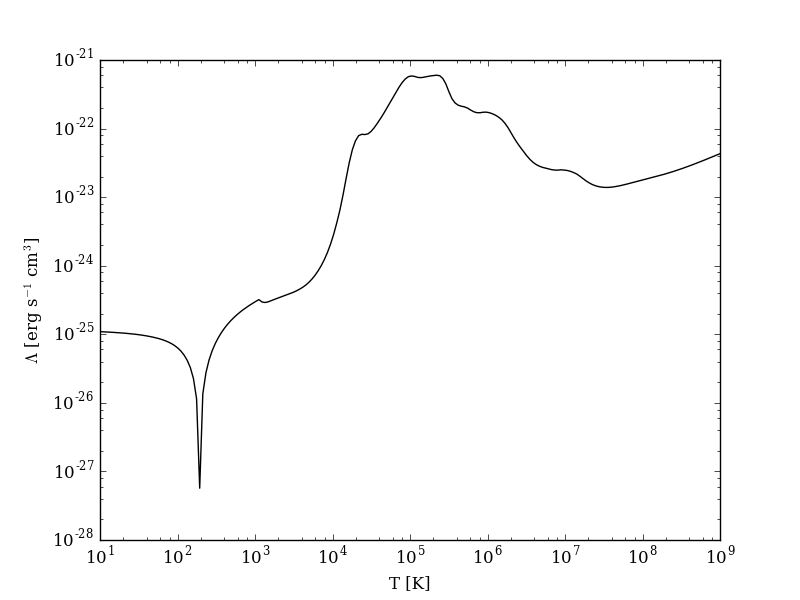
After the script runs, and hdf5 file will be created with a similar name. This can be loaded in with yt.
>>> import yt
>>> ds = yt.load("cooling_rate.h5")
>>> print ds.data["temperature"]
[  1.00000000e+01   1.09698580e+01   1.20337784e+01   1.32008840e+01, ...,
   7.57525026e+08   8.30994195e+08   9.11588830e+08   1.00000000e+09] K
>>> print ds.data["cooling_rate"]
[  1.09233398e-25   1.08692516e-25   1.08117583e-25   1.07505345e-25, ...,
   3.77902570e-23   3.94523273e-23   4.12003667e-23   4.30376998e-23] cm**3*erg/s
Cooling Cell Example
This sets up a single grid cell with an initial density and temperature and solves the chemistry and cooling for a given amount of time. The resulting dataset gives the values of the densities, temperatures, and mean molecular weights for all times.
~/grackle/src/python/examples $ python cooling_cell.py
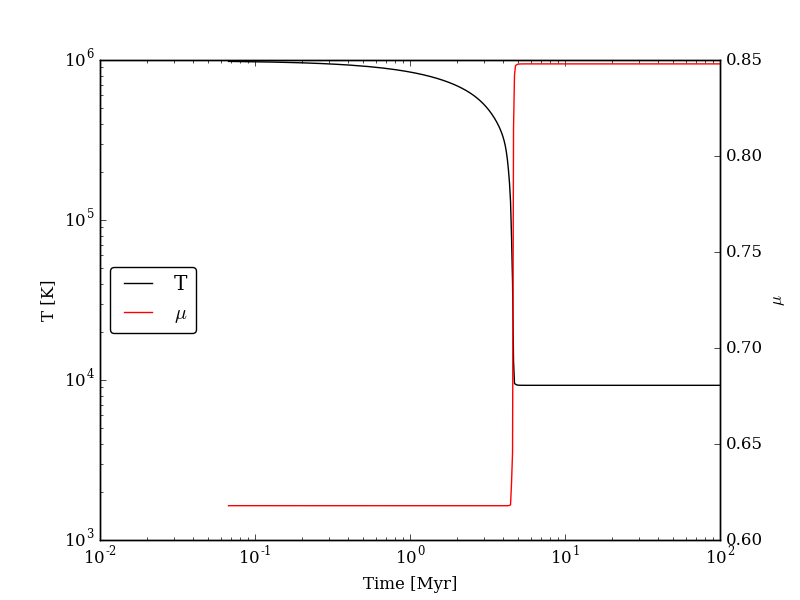
>>> import yt
>>> ds = yt.load("cooling_cell.h5")
>>> print ds.data["time"].to("Myr")
YTArray([  0.00000000e+00,   6.74660169e-02,   1.34932034e-01, ...,
         9.98497051e+01,   9.99171711e+01,   9.99846371e+01]) Myr
>>> print ds.data["temperature"]
YTArray([ 990014.56406726,  980007.32720091,  969992.99066987, ...,
          9263.81515866,    9263.81515824,    9263.81515865]) K
Free-Fall Collapse Example
This sets up a single grid cell with an initial number density of 1 cm-3. The density increases with time following a free-fall collapse model. As the density increases, thermal energy is added to model heating via adiabatic compression. This can be useful for testing chemistry networks over a large range in density.
~/grackle/src/python/examples $ python freefall.py
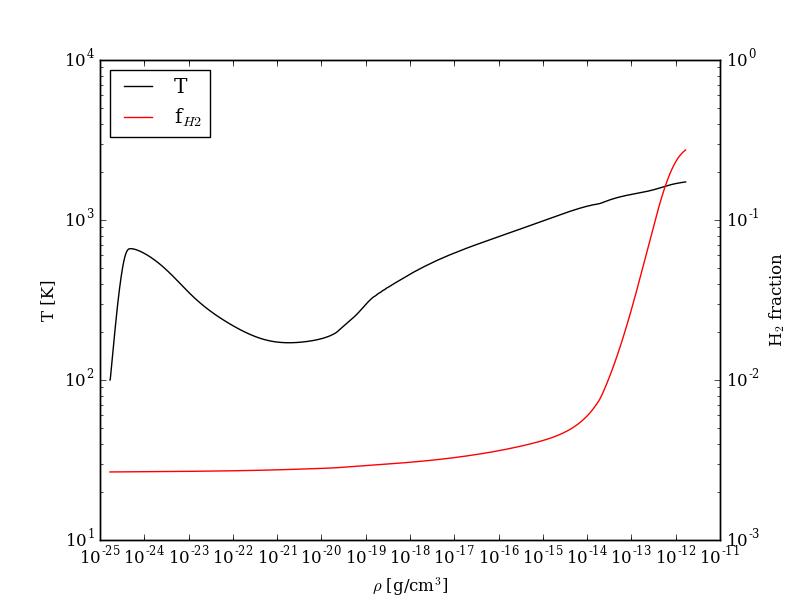
The resulting dataset can be analyzed similarly as above.
>>> import yt
>>> ds = yt.load("freefall.h5")
>>> print ds.data["time"].to("Myr")
[   0.            0.45900816    0.91572127 ...,  219.90360841  219.90360855
  219.9036087 ] Myr
>>> print ds.data["density"]
[  1.67373522e-25   1.69059895e-25   1.70763258e-25 ...,   1.65068531e-12
   1.66121253e-12   1.67178981e-12] g/cm**3
>>> print ds.data["temperature"]
[   99.94958248   100.61345564   101.28160228 ...,  1728.89321898
  1729.32604568  1729.75744287] K
Using Grackle with yt
This example illustrates how Grackle functionality can be called using
simulation datasets loaded with yt as
input. Note, below we invoke Python with the -i flag to keep the
interpreter running. The second block is assumed to happen within the
same session.
~/grackle/src/python/examples $ python -i yt_grackle.py
>>> print (sp['gas', 'grackle_cooling_time'].to('Myr'))
[-5.33399975 -5.68132287 -6.04043746 ... -0.44279721 -0.37466095
 -0.19981158] Myr
>>> print (sp['gas', 'grackle_temperature'])
[12937.90890302 12953.99126155 13234.96820101 ... 11824.51319307
 11588.16161462 10173.0168747 ] K
Through gracklepy, the following yt fields are defined:
('gas', 'grackle_cooling_time')('gas', 'grackle_gamma')('gas', 'grackle_molecular_weight')('gas', 'grackle_pressure')('gas', 'grackle_temperature')('gas', 'grackle_dust_temperature')
These fields are created after calling the add_grackle_fields function.
This function will initialize Grackle with settings from parameters in the
loaded dataset. Optionally, parameters can be specified manually to override.
Footnotes